UGC Contract Template: Free Download for Content Creators
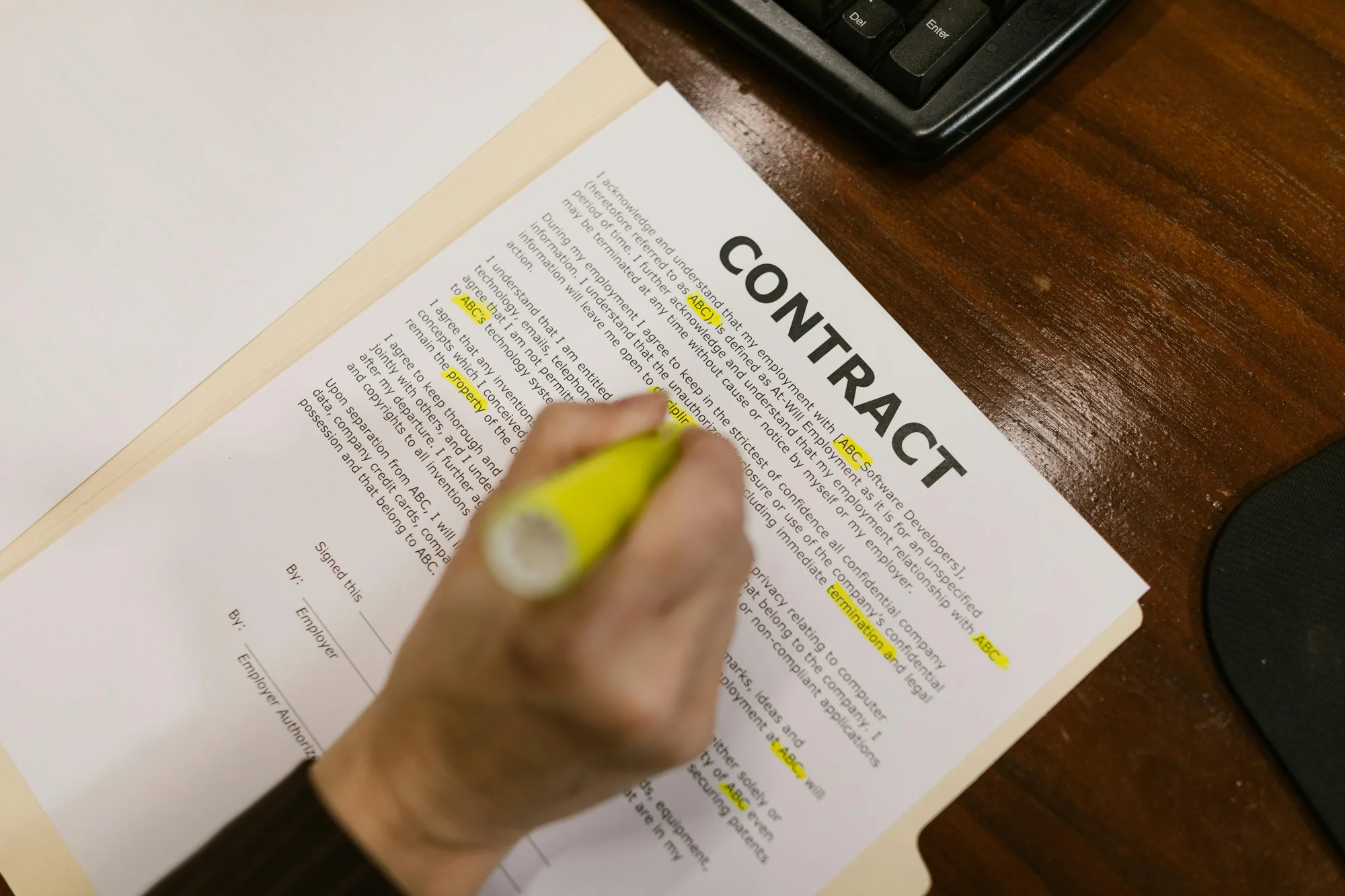
Every UGC creator and content creator who works with brands needs a contract for every deal — no exceptions. Without one, you have no legal basis to dispute a scope change, chase a late payment, or prevent a brand from using your content beyond what was agreed. A contract is not about distrust. It is the minimum standard for operating as a professional.
This guide includes a free UGC contract template you can download and customize, a clause-by-clause explanation of what each section does and why it matters, and the most common contract mistakes UGC creators and influencers make.
The Free UGC Contract Template
Below is a complete UGC creator contract template covering every essential clause. Fields in orange are placeholders — replace them with your specific deal details before sending. Download the editable version using the button below the template.
Creator agrees to produce the following content for Brand:
[e.g. Two (2) UGC video ads, 30–60 seconds each, vertical format (9:16), featuring [Product Name]. One (1) additional b-roll package of 10 raw clips.]
All content will be delivered in [MP4 / MOV / JPEG] format via [Google Drive / WeTransfer / platform link] by [Delivery Date].
Creator will produce content in accordance with the brief provided by Brand on [Brief Date]. Any material changes to the brief after this date may require a revised fee.
Total fee: $[Amount], comprising:
Content creation fee: $[Amount]
Usage rights license fee: $[Amount] (see Section 4)
Payment schedule: A deposit of 50% is due upon signing. The remaining balance is due within [14 / 30] days of final content delivery.
Late payments: Overdue amounts will accrue interest at 1.5% per month from the due date.
Payment method: [Bank transfer / PayPal / Wise]
Creator grants Brand a [non-exclusive / exclusive] license to use the delivered content for the following purposes only:
Platforms: [e.g. Meta paid advertising (Facebook and Instagram), TikTok paid advertising]
Duration: [e.g. 12 months from the date of delivery]
Territory: [e.g. Worldwide / United States only]
Use of the content beyond these terms — including on additional platforms, after the license period, or for whitelisting / allowlisting — requires a new written agreement and additional fee. Creator retains full copyright ownership of all delivered content.
This agreement includes [2] rounds of revisions at no additional cost. A revision round is defined as a consolidated set of feedback delivered in a single communication. Additional revision rounds beyond this limit will be billed at $[Hourly Rate] per hour or $[Flat Fee] per round, invoiced separately.
Brand agrees to provide feedback within [5] business days of receiving content. If no feedback is received within this period, content will be deemed approved.
If Brand cancels this agreement after work has commenced, the following kill fee applies:
Cancellation before first draft delivery: 50% of total fee
Cancellation after first draft delivery: 100% of total fee
In the event of cancellation, any deposit already paid is non-refundable. Creator retains all rights to delivered content unless otherwise agreed in writing.
Creator agrees to include a clear and conspicuous disclosure of the commercial nature of this content in all published material, consistent with the FTC Endorsement Guides (16 CFR Part 255) and applicable advertising regulations. Accepted disclosure language includes #ad, #sponsored, or equivalent. Both parties acknowledge their respective obligations under applicable advertising disclosure laws.
Both parties agree to keep the terms of this agreement, including the fee, confidential. Neither party will disclose the terms to third parties without the prior written consent of the other, except as required by law.
Creator agrees not to produce sponsored content for direct competitors of Brand in the category of [category, e.g. skincare / protein supplements] for a period of [30 / 60 / 90] days from the date of delivery. This exclusivity is limited to the category specified above and does not restrict Creator from working with brands in other categories.
This agreement is governed by the laws of [State / Country]. Any disputes arising from this agreement will first be addressed through good-faith negotiation. If unresolved, disputes will be submitted to binding arbitration in [City, State / Country].
This agreement constitutes the entire agreement between the parties and supersedes all prior discussions or arrangements. Any amendments must be made in writing and signed by both parties.
📄 Get the free UGC contract template
Open the Google Docs version, make a copy, and customize it with your own details. Ready to send to brands in minutes.
Get free UGC contract templateOpens in Google Docs — File → Make a copy to edit
Every Clause Explained
1. Parties
Use your full legal name — not just your creator handle. If you operate through a business entity, use the registered business name. Getting the parties section right matters if you ever need to enforce the contract legally.
2. Deliverables
Be precise. Vague deliverables are the root cause of most UGC contract disputes. Specify the content type, format, length, aspect ratio, number of pieces, and delivery date. If the brand is sending a product, include when you expect to receive it. The more specific the deliverables section, the harder it is for a brand to request something you did not agree to. For the complete list of what every brand deal contract needs, see what to include in a brand deal contract.
3. Payment
Always separate the content creation fee from the usage rights fee. Always require a deposit before starting work. The deposit is not optional — it is the mechanism that separates brands who will pay from brands who will not. A brand that refuses a deposit is showing you how they will behave when your invoice is due. For a full guide to payment terms and structures for creators, see what payment terms to use for brand deals.
4. Revisions
Unlimited revisions is not a clause — it is an invitation to spend months on a single deal. Define what a revision round means (consolidated feedback in one message, not ongoing changes), how many are included, what the additional cost is, and how long the brand has to provide feedback. The deemed-approved clause is critical: if a brand does not respond within your specified window, the content is approved and payment is due.
Usage Rights — The Most Important Clause
Usage rights determine how, where, and for how long the brand can use your content. For UGC creators specifically, this clause carries more financial weight than the content creation fee itself in many deals — because a brand running your video in paid ads for two years is generating far more value than the cost of producing it.
The four variables to define in every usage rights clause are the platforms (Meta, TikTok, YouTube, brand website, email), the type of use (organic posting, paid advertising, whitelisting), the duration (6 months, 12 months, perpetual), and the territory (worldwide or specific countries). Each of these variables affects the price.
Perpetual rights with whitelisting is the most expensive combination and should be priced significantly higher than a time-limited organic license. A brand that wants to run your content as paid ads indefinitely on all platforms is getting something that warrants a premium, not a bundled-in flat rate. For the complete breakdown of usage rights types and how to price each one, see content usage rights for creators: what they are and how to charge for them.
What happens when usage rights expire: If a brand is still running your content after the license period ends, that is unauthorized use. You are entitled to either a new licensing fee or for the content to be taken down. Document your delivery dates and license expiry dates for every deal — this is the only way to catch it.
Kill Fee and Cancellation
A kill fee protects you when a brand cancels after you have already invested time in the project. Without one, a brand can cancel mid-production and owe you nothing — even if you spent hours filming, editing, or purchasing props.
The standard structure is 50% if the cancellation happens before first draft delivery, and 100% if it happens after. This is fair because by the time you have delivered a draft, you have completed the majority of the work. The deposit you collected upfront counts toward the kill fee amount. For a full explanation of how kill fees work and how to include them correctly, see what is a kill fee and how do content creators use it.
Reviewing a Brand’s Contract
When a brand sends you their own contract rather than signing yours, read it carefully before accepting. The clauses most likely to work against you are in usage rights (look for "in perpetuity," "worldwide," and "all media" without additional compensation), revision limits (many brand contracts include unlimited revisions), exclusivity scope (watch for clauses that prevent you from working with any competitor brand, not just direct ones), and payment triggers (avoid clauses where payment is tied to "when we run the content" rather than a specific date after delivery).
You are allowed to negotiate any clause in a brand’s contract. Responding with "I’d like to adjust the usage rights clause to reflect a 12-month license on paid media only, as we discussed" is professional and expected. Brands who refuse any negotiation are a red flag. For the full list of what to look for when reviewing a brand’s contract, see do content creators need a contract for brand deals.
Common UGC Contract Mistakes
Starting work before the contract is signed. The contract is not a formality — it is the legal foundation of the deal. Starting before it is signed means you have no enforceable agreement if something goes wrong.
Not requiring a deposit. A deposit is your primary protection against non-payment. It is also a filter: brands that refuse a reasonable deposit are telling you something important about how they handle payment.
Vague deliverables. "Two UGC videos" is not a deliverable. "Two UGC video ads, 30–60 seconds each, vertical 9:16 format, featuring [product], with one revision round included" is a deliverable.
Bundling usage rights into the base rate. This is the most expensive mistake UGC creators make. When usage rights are bundled, you have no basis to charge more if the brand extends their usage, changes platforms, or wants whitelisting access that was not in the original brief.
No revision limit. Without a cap on revisions, a brand can request changes indefinitely without additional cost. Define what a revision round is, how many are included, and what the additional fee is for going beyond that limit.
No kill fee clause. If a brand cancels after you have started work, a kill fee clause is your only protection. Without it, you have no contractual basis to claim compensation for work already done.
8 contract templates built for UGC creators and influencers
Dealvio includes professionally structured contract templates — sponsored post, UGC, ambassador, affiliate, whitelisting, and more — with the right clauses already in place. Generate, customize, and send in minutes.
Start free trial — no credit card requiredFrequently Asked Questions
A UGC contract should include the names and details of both parties, a description of the deliverables, the timeline and deadline, the payment amount and terms, the number of revision rounds included, the usage rights being granted (including platform, duration, and type of use), a kill fee clause for brand cancellations, and the governing law. Confidentiality and exclusivity clauses are optional but common.
Yes, every time. A contract is the only document that legally defines what you agreed to produce, what you will be paid, how your content can be used, and what happens if things go wrong. UGC creators who work without contracts have no legal basis to dispute scope changes, late payments, or unauthorized use of their content.
A UGC contract is a written agreement between a content creator and a brand that defines the terms of their collaboration. It specifies the deliverables, payment, usage rights, revision limits, and legal protections for both parties. Unlike influencer contracts which focus on audience reach, UGC contracts focus on content ownership and licensing since the creator is producing content for the brand to use on its own channels.
Start with the names and contact details of both parties, then define the deliverables in precise detail including content type, platform, length, and deadline. Add a payment section with the total amount, payment terms, and a deposit requirement. Include a usage rights clause specifying the platforms, duration, and type of use. Add a revision clause limiting the number of rounds included. Finish with a kill fee clause, confidentiality, governing law, and signature lines.
Yes. A well-structured free UGC contract template provides a solid starting point for most brand deals. Customize the placeholders with your specific deliverables, rates, and usage terms before sending. For deals involving large payments, complex usage rights, or brands in regulated industries, having a lawyer review the contract is recommended.